Week 9. Bookkeeping: parameters, FLOPs, memory
Learn in the app: tutor, coding problems →
Core: parameters by component, 6N FLOPs, training and inference memory, KV cache size · Depth: exact activation memory, MFU and training cost, total versus active MoE parameters · ≈ 11 h core / 21 h total
This gets its own week because interviewers ask about it almost every time, and almost everyone gets the numbers wrong. Every decision later on starts from these formulas: how many GPUs, what batch size, whether the context fits, whether parallelism pays off (week 14). You need to be able to derive them, not recall them.
Step 1. Parameters
- Parameters by component: embeddings
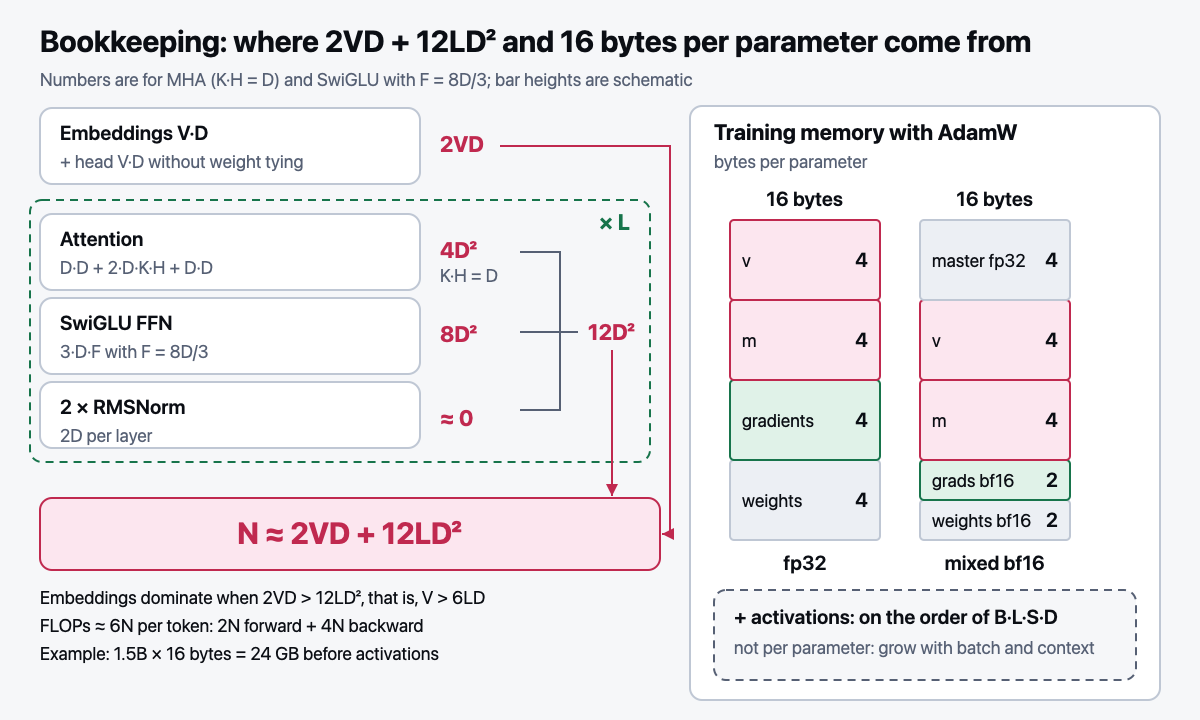
V·D, attentionD·D + 2·D·K·H + D·D, FFN3·D·F, norms. With MHA (K·H = D) attention gives4D², and SwiGLU withF = 8D/3gives3·D·8D/3 = 8D². That is12D²per layer, plus the input embedding and the head,2VD:N ≈ 2VD + 12LD²(norms add2Dper layer; we drop them when rounding) - Sanity check on Llama-3-8B: the formula gives
1.05B + 6.44B = 7.49B, while the real count is 8.03B. The gap is honest: GQA shrinks attention (1.34B instead of 2.15B), andF = 14336 = 3.5Dinflates the FFN (5.64B instead of 4.29B) - Embeddings dominate when
2VD > 12LD², that is, whenV > 6LD. In GPT-2 small they are about a third of all parameters
Step 2. FLOPs
In plain terms. On every token, each weight is multiplied once and added once:
2 operations. The backward pass does that work twice: it computes the gradient with respect to the layer input,
to pass it further back, and the gradient with respect to the weight itself. Total: 2 + 4 = 6 operations per weight per token.
A 1B-parameter model on 20B tokens: 6 · 10⁹ · 2·10¹⁰ = 1.2·10²⁰ FLOPs.
- FLOPs: forward ≈
2Nper token, backward ≈4N, total6Nper token (N = number of parameters). The basis is simple: a matmul(b×n)·(n×m)costs2bnm. Embeddings are not part ofNhere: they are a row lookup, not a multiplication- The attention contribution
~4·B·N·S²·H, and when it starts to dominate the matmuls. This comes fromQKᵀandAV,2·B·N·S²·Heach per layer in the forward pass. Per token, with backward, that is12·L·S·D. Against6N ≈ 72LD²the threshold isS ≈ 6D; for Llama-3-8B (budget.py) that is about 26.6k
- The attention contribution
- The
D×Vhead is a real matmul, another6VDper token. Inflops_per_tokenit has its own line,lm_head: for Llama-3-8B it is ~3.2 GFLOPs, about 6% of the total - MoE: total vs active parameters. In an MoE layer (mixture of experts, week 19), instead of one FFN
there are
Eexperts, and a router sends each token tokof them. In plain terms. 24 layers, each with 20M of attention and 8 experts of 60M, top-2. Total parameters:24·(20 + 8·60)M = 12.0B; active per token:24·(20 + 2·60)M = 3.36B. FLOPs are counted from the active ones:6 · 3.36·10⁹ ≈ 2·10¹⁰per token in training. Memory is counted from the total: 24 GB of weights in bf16, 192 GB at 16 bytes for AdamW. In decode with a large batch, tokens spread across all experts: a step reads all 12B but computes like 3.36B. That is why the critical batch (week 13) for MoE is higher by about12 / 3.36 ≈ 3.6×. DeepSeek-V3 has 671B total parameters and 37B active: the memory of a giant, the arithmetic of a mid-size model
Step 3. Memory
In plain terms. When you train with AdamW, every parameter carries five "cards": the weight in bf16 (2 bytes), the gradient in bf16 (2), an exact fp32 copy of the weight (4), and two Adam moments in fp32 (4 + 4). Total: 16 bytes. A 7B model takes 112 GB before any activations: it no longer fits on a single 80 GB H100.
- Activations: what is stored for backward, and where
O(B·L·S·D)comes from. Each matmul stores its input, SwiGLU stores the intermediateB·S·F, and naive attention also stores theB·N·S²matrix (the formula is in05-ГЛУБИНА). For Llama-3-8B at batch 8 × 8192 that is 384 GiB, versus 120 GiB for the states. The cures are checkpointing (week 2) and microbatches - Training memory: parameters + gradients + Adam states (m, v) + activations.
For fp32 AdamW this is 16 bytes per parameter; for mixed precision you have to count carefully:
2 + 2 + 4 + 4 + 4, again 16. Mixed precision saves on activations and speed, not on states - Inference memory: weights + KV cache =
2 · B · S · L · K · H · bytes. Derivation: for every token, in every layer, you store a key and a value (2), each withKheads of sizeH. Llama-3-8B, bf16: 128 KiB per token, 1 GiB per 8k of context; with MHA it would be 4 GiB - How much the KV cache weighs. Weights do not depend on the batch; the cache grows linearly with it. The cache equals the weights at
B = weight bytes / (S · 2 · L · K · H · bytes). For Llama-3-8B at 8k this is16.06 GB / 1.07 GB ≈ 15sequences, at 4k about 30. Beyond that, the cache is the main consumer of both memory and step time: decode reads all of it for every new token (week 11,decode_step_time) - MFU (model FLOPs utilization), the measure of training efficiency: the fraction of peak delivered by
useful FLOPs (
6Nplus attention per token × tokens per second). Recomputation from checkpointing does not count. Well-tuned training reaches 35–50%;training_timeuses 45% by default
Common mistakes
- Computing the KV cache with
Ninstead ofK: caught bytest_gqa_saves_kv_cache_exactly_N_over_K. Forgetting the factor of 2 for K and V: caught bytest_kv_cache_formula,test_kv_cache_size_formula - Including embeddings in
6N: caught bytest_flops_rule_of_6N. UsingF = 4Dfor SwiGLU: caught bytest_swiglu_ffn_dim_is_8D_over_3 - Counting tied embeddings twice (
tie_embeddingsinSpec); mixing up GB and GiB (a 7% difference, no test will catch it) - For MoE, counting
6Nfrom the total parameters and memory from the active ones. It is the other way round: FLOPs from active, memory from total
Code → nanolm/budget.py: a calculator. Input: a model config and hardware (Spec). Output:
parameter_breakdown, flops_per_token, training_memory, inference_memory, training_time, report.
Run: python -m nanolm.budget --V 128256 --D 4096 --L 32 --N 32 --K 8 --S 8192 --F 14336,
tests: pytest tests/test_budget.py -v (the key one is test_llama3_8b_parameter_count). Inside the model the same quantities
are computed by NanoLM.num_parameters, flops_per_token, kv_cache_bytes. Check the predictions by measuring
with torch.cuda.max_memory_allocated() (on a Mac, torch.mps.current_allocated_memory()).
Math (Track D): D9: estimating the training time of a 7B model from 6N, MFU and GPU count;
D10: Stirling and order-of-magnitude estimates with large numbers.
Interview question of the week: "Will full fine-tuning of a 7B model fit on one 80 GB H100?" A 3-minute structure: 16 bytes per parameter → 112 GB of states, no → what to shard (ZeRO/FSDP, week 14) → what to compress (8-bit Adam moments) → activations: checkpointing, microbatches → the alternative: LoRA (week 15).
Sources: Kaplan et al., Scaling Laws (2020), the origin of 6N; Korthikanti et al., *Reducing Activation
Recomputation* (2022); Chowdhery et al., PaLM (2022), the origin of MFU; Pope et al., *Efficiently Scaling Transformer
Inference* (2022), which counts inference memory and time the same way; DeepSeek-V3 (2024), total and active MoE parameters.
Deeper: 05-ГЛУБИНА, section "Week 9. Accounting: exact formulas instead of 'roughly'".
Week outcomes
- I can derive
N ≈ 2VD + 12LD²(for MHA) from the sum over components and say when embeddings dominate. - I can estimate training time in 5 minutes from
6Nper token, the token count and peak FLOPs, accounting for MFU. - I can compute the KV cache for a given model, batch and context, and the batch at which it catches up with the weights.
- I can separate total and active MoE parameters: which go into FLOPs and which into memory.
- I can write the
budget.pycalculator and confirm the memory forecast by measurement. - I can explain why the formula gives 7.5B for Llama-3-8B while the real count is 8.03B.
Self-check
- Where do the 2 and the 4 in
6Ncome from? - At what context length does attention start to dominate the matmuls, and why?
- What makes up the 16 bytes per parameter with AdamW in fp32, and what changes with mixed precision?